Product
Amal AP-LIS
Built by a practicing pathologist around the way pathology labs actually work. Amal AP-LIS carries a case from accessioning to signed-out report with the structure, quality controls, and audit rigor of a CAP-inspected laboratory — without forcing the workflow to bend to the software.
01
The complete anatomic pathology workflow
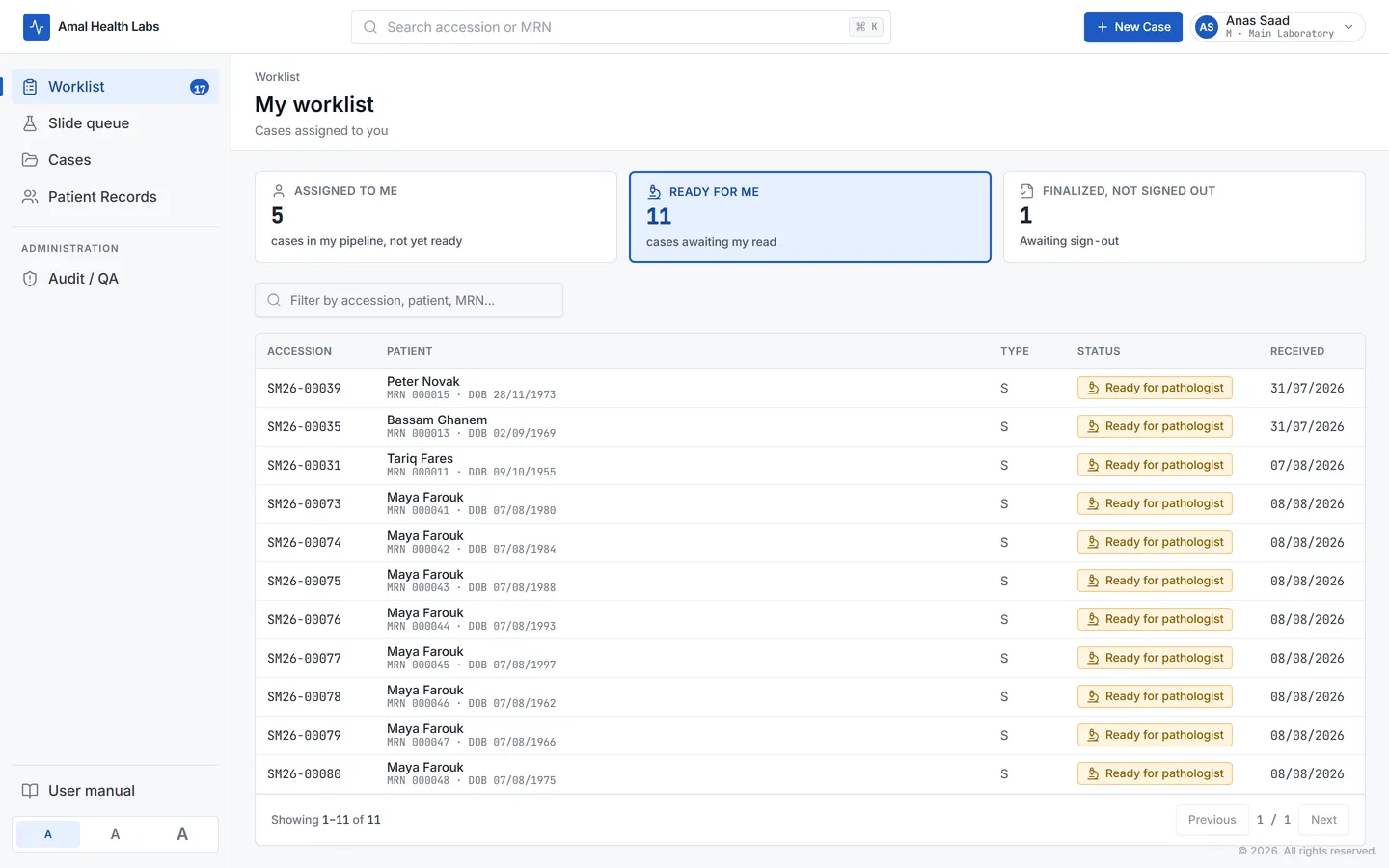
Accessioning, part entry, grossing, blocks, and stain/slide items in one traceable hierarchy: Case → Part → Block → Slide. Cases move through explicit, visible statuses — accessioned, grossed, ready for pathologist, finalized, signed out — with staff and pathologist worklists routing work to the right person.
02
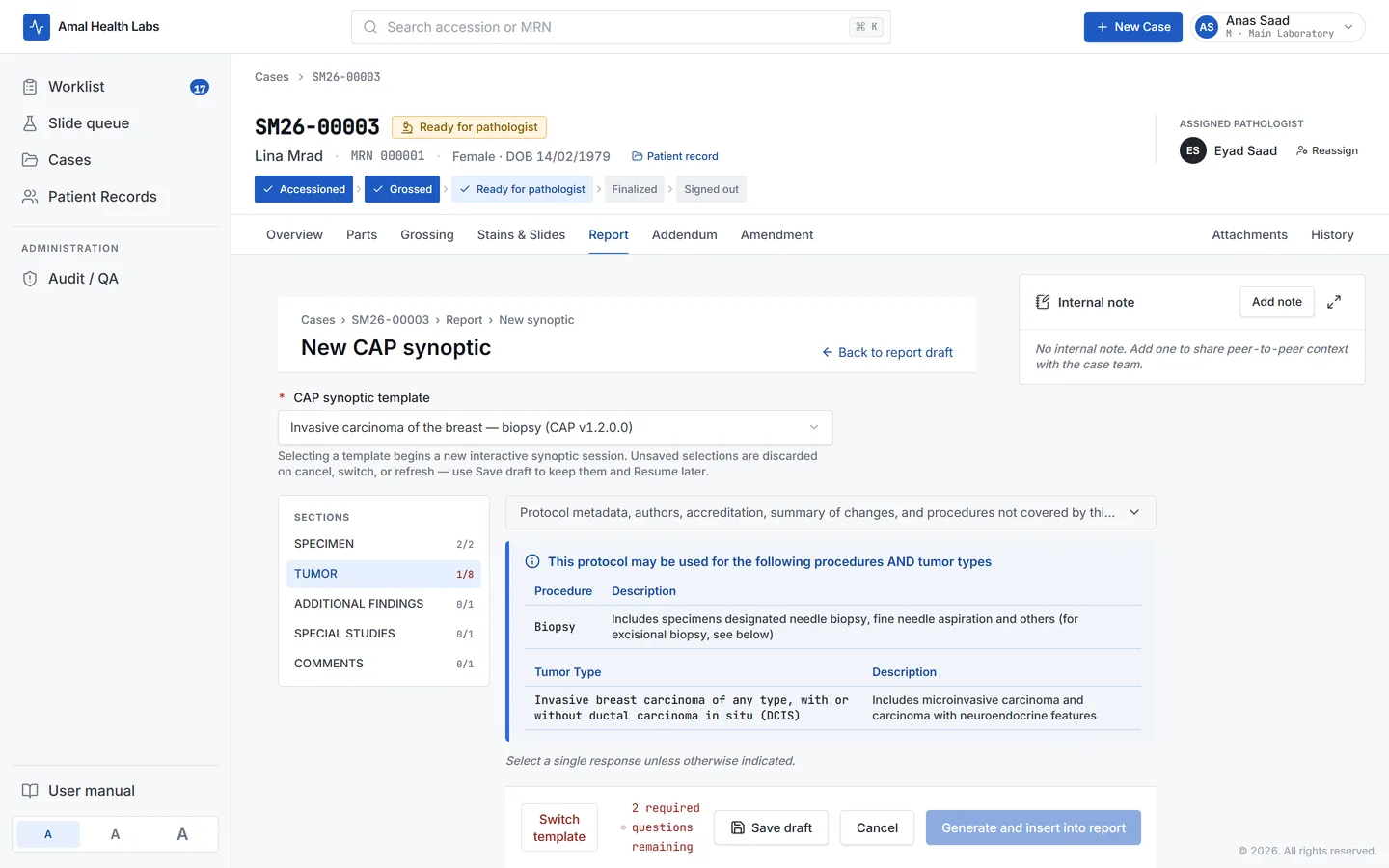
CAP-aligned synoptic reporting
The full suite of 55 CAP cancer protocol templates, entered interactively with question-level CAP guidance available in the workflow, then rendered directly into the report. Save drafts mid-protocol, resume, and regenerate with previous answers preserved.
03
Sign-out you can defend
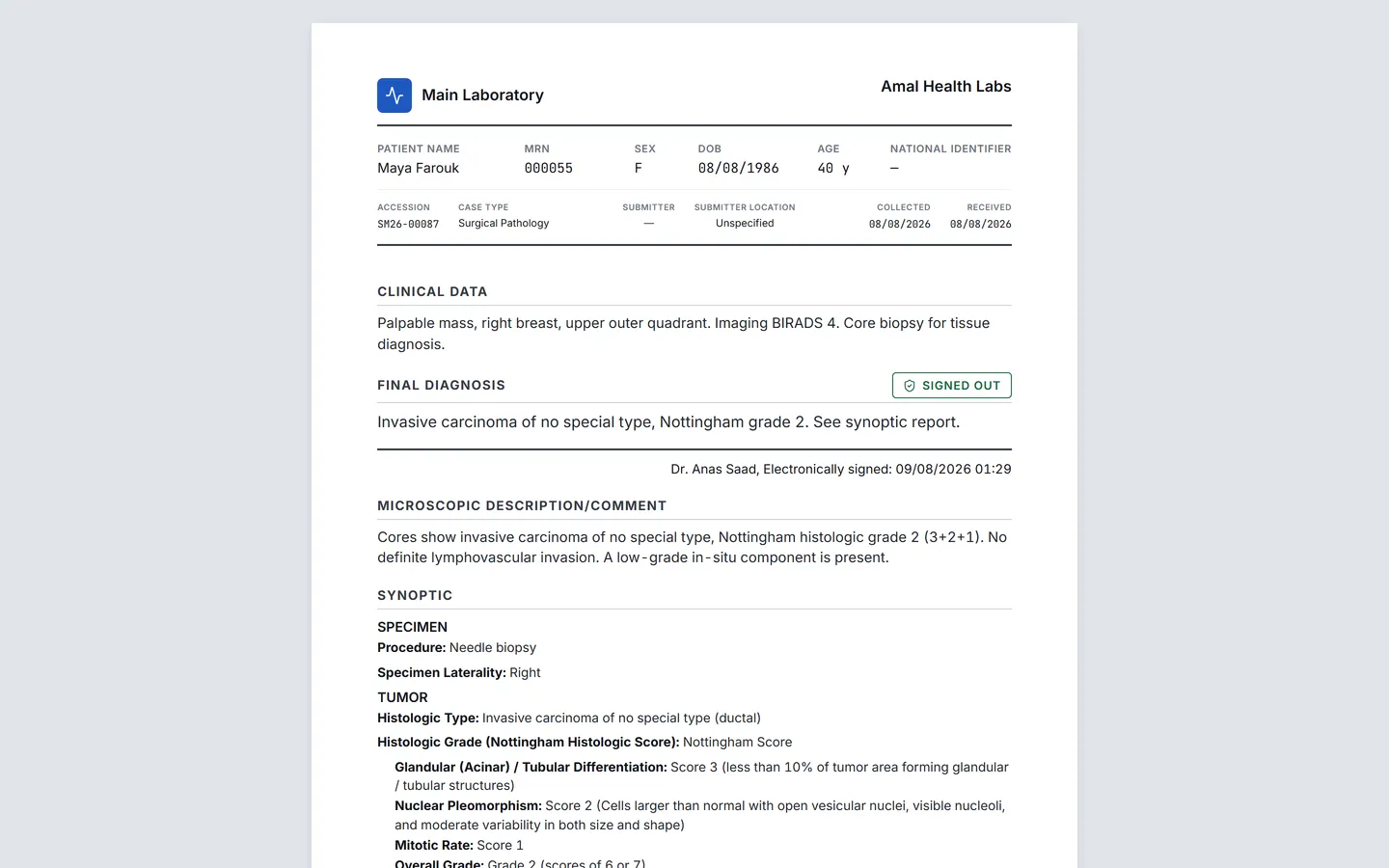
Sign-out requires re-authentication and produces an immutable report version. Post-sign-out changes happen only through explicit addenda and reason-classified amendments; every released version is preserved, and nothing is ever silently overwritten.
04
QA and operational dashboards
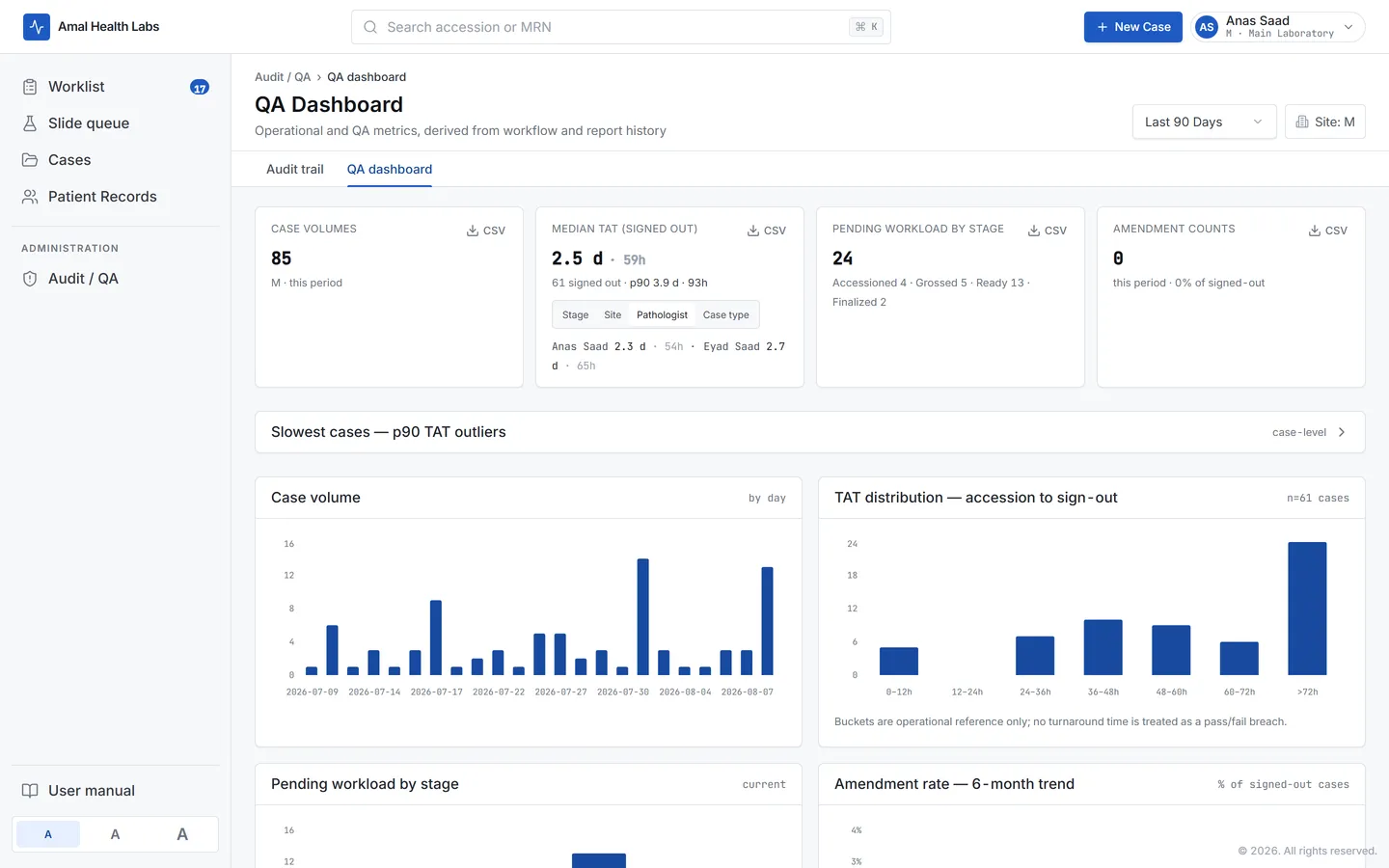
Turnaround time, pending workload, case volumes, amendment trends, and slide-quality metrics — derived from actual workflow events, not manual tallies.
05
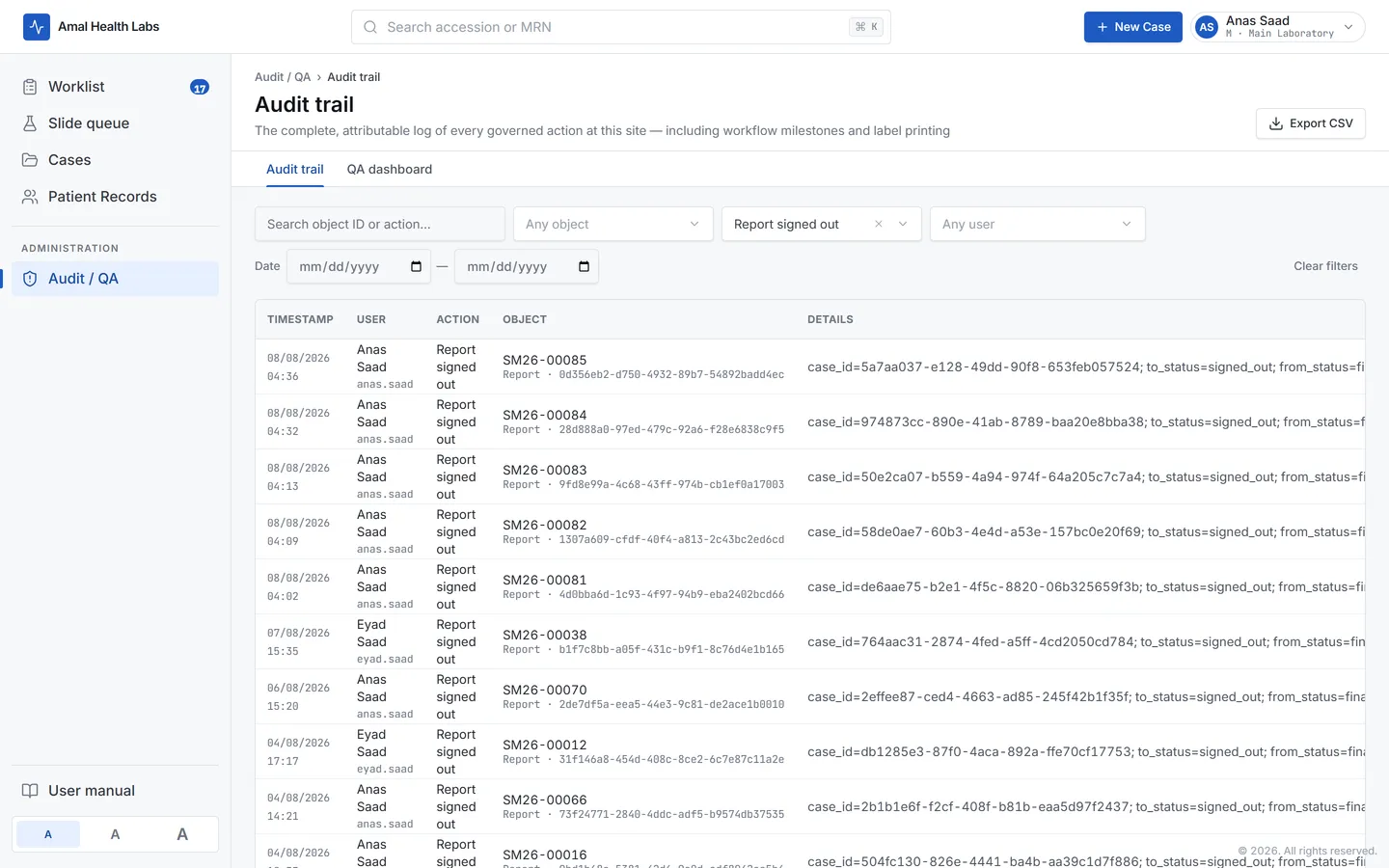
A complete audit trail
Every governed action — every edit, transition, print, and sign-out — emits an audit event. Filterable, site-scoped review surfaces with export, built for inspection readiness.
06
Multi-site by design
Site-scoped access with role and capability-based permissions, per-site configuration, and controlled cross-site visibility for organizations running more than one laboratory.
07
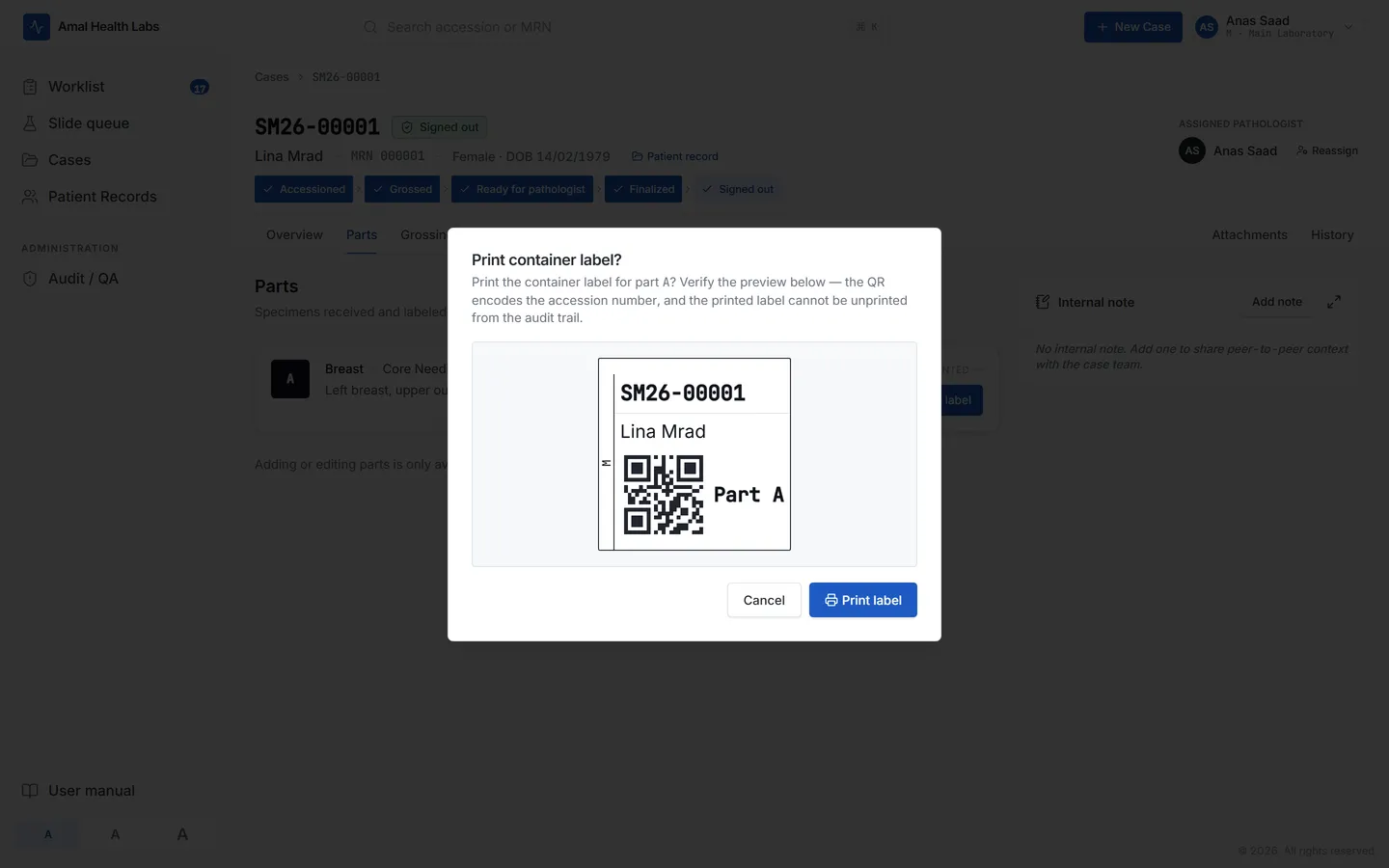
Labels and barcoding
Slide and specimen-container labels with QR codes, printed from the workflow with full print and reprint history.
08
Deployed your way
Delivered as containerized software, licensed per deployment, with per-laboratory branding and configuration.
Full capability list
Case management & workflow
- Case accessioning — configurable numbering schemas, case types, and required-field sets per site
- Patient registration — org-wide duplicate detection at entry
- Submitter / referring-source capture
- Part entry — body site, procedure, descriptive qualifiers per part
- Grossing — gross descriptions, block creation and tracking
- Stain/slide workflow — ordered → ready → archived lifecycle; site-wide slide work queue
- Pathologist assignment — assign, reassign, bulk assignment
- Staff and pathologist worklists
- Concurrency control — single-editor case lock
- Specimen provenance — collected and received date capture
Reporting & sign-out
- Rich-text report drafting with autosave
- Report templates per site and case type
- CAP synoptic reporting — 55 CAP cancer protocol templates, interactive entry, embedded CAP guidance, draft save/resume, regenerate with answers preserved
- Finalization and sign-out with identity re-authentication
- Immutable signed-out report versions
- Addenda
- Reason-classified amendments with cumulative amendment notices
- Data-quality gate — unresolved placeholders block finalize/sign-out
- Print-ready reports with configurable letterhead
- Report-embedded case images
Quality & compliance
- QA dashboard — turnaround time, pending workload, case volumes, amendment trends, slide-quality metrics
- Complete audit trail — every governed action recorded; filterable, exportable review surfaces
- Per-case workflow event history
- Label print and reprint history
- Internal case notes, separate from the report
Patients & data
- Patient search and longitudinal case history
- Controlled post-accession patient identity correction
- Case attachments — documents and images with governed lifecycle
- Image attachments embeddable in reports
Labels & printing
- QR-coded slide labels
- Specimen-container labels
- Browser-based printing to standard label printers
Access control & administration
- Role templates with capability-group permissions and bounded per-user overrides
- Sign-out permissions restricted to pathologist roles
- Site-scoped assignments — read-only or write access per site
- User administration — account lifecycle, lockout, password policy
- Session security — inactivity timeout, re-authentication for sign-out
- Configuration catalogs — body sites, procedures, stains, case types, numbering, templates, submitters
- Per-site display and letterhead preferences
Multi-site
- Multiple laboratory sites in one deployment
- Per-site configuration and access scoping
- Controlled cross-site visibility
Deployment & security
- Containerized delivery, licensed per deployment
- Per-laboratory branding and naming
- Account lockout, password strength enforcement, encrypted sessions
- Documented backup and recovery procedures
Interoperability
- HL7 v2 interfaces — orders, results, ADT
- FHIR API
- Electronic report delivery to EMRs and referring systems
- Native integration with the Amal EMR — coming soon
See the AP-LIS in action.
Request a demo